
Eating on Yom Kippur: How Much, and How Often
While we all wish to start and finish a successful fast, not everyone can have one. For them, a chart and a plan.
BS"D
While we all wish to start and finish a successful fast, not everyone can have one. For them, a chart and a plan.
In this post:
Not everyone who wishes to fast can. When your doctor and your Rav say you cannot fast, your mitzvah is a different one. It may be a slim young teenager. It may be someone who is prone to reaching high levels of ketones quickly. It may be for a good reason like pregnancy or nursing, or any other reason. Whatever it is, the same way we supply instructions on how to set the pump in order to fast, we want to supply instructions on how to eat.
This post is not about low blood sugars. The occasional low, which you treat and then continue the fast, is a different subject. This is about the person who needs to eat regularly through the day — or the person who has to start eating and drinking in the middle of the fast because of symptoms of DKA or high levels of ketones.
The Amounts
Eating on Yom Kippur means eating pachos m’kshiur — less than the amount halacha counts as “eating.”
Food: less than a small schnapps cup, about 25 to 30 mL.
Drink: less than a cheekful (מלא לוגמיו), under 40 mL. Half a mouthful is certainly less.
The waiting times: nine minutes between one eating and the next; five minutes between one drink and the next. At one sitting you may eat the allowed food and drink the allowed drink simultaneously.
These measurements are volumes, not weights, and volume of food is hard to judge on the day itself. The reason is that the shiur is the volume of the food itself, not the space it takes up. To measure a cookie you would have to crumble it to flour and pack it into the cup with no air trapped. Nobody is doing that on Yom Kippur. Our own Rav did exactly that once, on our behalf, for Winkie rolls — crushed them, packed them, and measured the volume — which is how we know that four of them are still less than the shiur. Something like cottage cheese fills a cup with no air and can be measured directly; anything solid cannot. That is what the pictures and the prepared portions are for.
One sefer is worth having on the table: The Halachos of K’zayis by Rabbi Yisroel Pinchos Bodner, from Feldheim. It has full-size photos of a k’zayis of common foods, and a k’zayis is less than the Yom Kippur shiur (ככותבות), so any amount pictured there is permissible. English and Hebrew editions, in seforim stores and on Amazon. Follow the pictures, or prepare the portions before Yom Kippur.
For drink, the precise tool is a medicine syringe — but drinking from a syringe on the day itself is not practical, and the little cups are easier. Cups are not all the same size, so before Yom Kippur draw up the exact amount allowed in the syringe and pour it into the cup you will use. If it fills the cup to the top, the cup is your measure. If it does not, make a mark on the outside at the line, and fill only to the mark.
The Five-Minute Clock
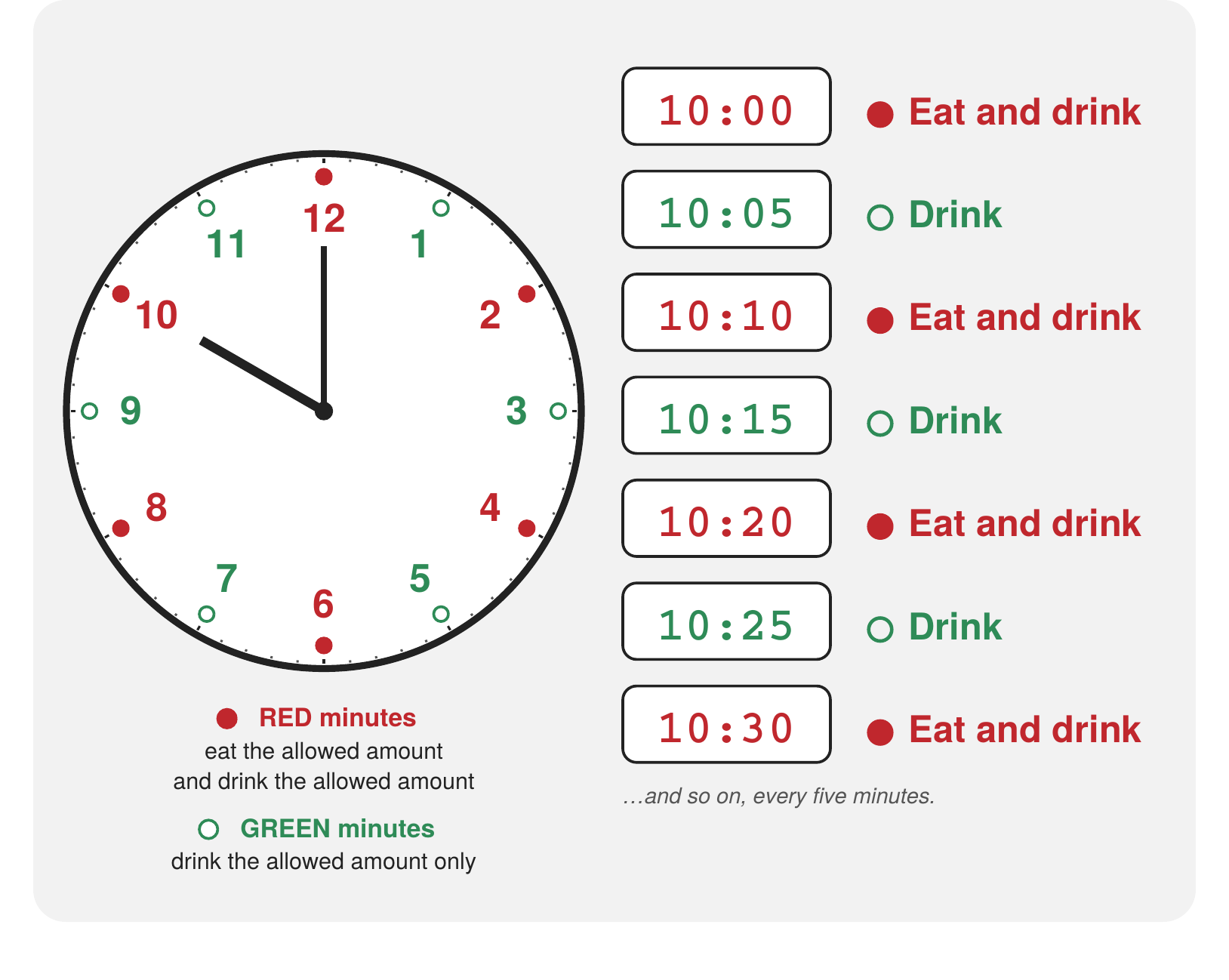
The simplest way to keep the timing is a pattern you can follow without thinking. Whenever your meal starts — 10:00 is only the example in the chart — eat the allowed amount and drink the allowed amount. Five minutes later, drink only. Five minutes after that, eat and drink again. Keep alternating: eat and drink, drink only, eat and drink, drink only. Every ten minutes you eat, every five you drink, and the pattern keeps you past nine minutes between eatings without counting.
How Much, and How Often
The question that comes up is: how much do I need to eat, and how often? There is no hard rule. What I usually tell people is to push in three or four small meals over the day.
A meal is half an hour on the clock above. In half an hour you can eat four times and drink seven times. Think of it as a small breakfast, a small lunch, a small dinner, and maybe a snack or two in between.
Those meals should have some carbs in them, so you can take insulin. It is also a good idea for them to have some protein, so the carbs do not shoot you up too high. Start with the protein, continue with the carbs, and time the boluses accordingly.
Between those meals, push in as much drink as you are allowed. Drinking matters a lot on this day. My usual suggestion for the drink is milk. It is a wholesome food, it gives you carbs and some protein, and the higher-fat version prevents a sharp rise in blood sugar.
Some ask whether they can get by with drinking only. From a practical standpoint it has a lot going for it. If the drink is milk, you are getting carbs and protein and taking insulin for them, and you are getting the fluids, all in one — and it is easier to keep up than eating and drinking on two different clocks. Whether halacha requires you to eat as well, or drinking alone is enough, is a question for your own Rav.
A Few More Things
Most doctors will agree that these amounts are enough. A few do not, and insist on eating normally. If yours is one of them, hand him a written plan of what you will eat and drink and when. Four eatings and seven drinks in half an hour, three or four times a day, adds up to more than it sounds, and doctors are often surprised by how much can be taken in this way in a short time.
If your blood sugar and ketones are high, there is no shiur on drinking.
If it is urgent — you bolused ahead of the meal and now the sugar is dropping faster than a half-hour meal can keep up with — the waiting times can be shortened. Between eatings, from nine minutes down to seven, five, or even four. Between drinks, from five minutes down to as little as half a minute. Ask your Rav beforehand what applies to you, not on the day.
The Quick Reference Sheet
Everything above is on one page, with the clock drawn out in red and green, here: The Five-Minute Clock. There is a PDF on the same page to print and carry into shul.
A reference sheet, not a psak. The shiurim and the waiting times follow the common practice; your own Rav decides what applies to you.
Wishing you a kesivah vechasimah tovah.
— Rabbi Hirsch Meisels